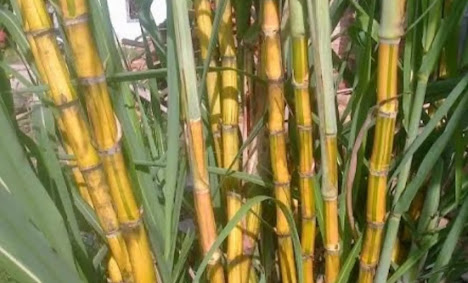
Sugarcane (Saccharum sp. hybrids) is a highly productive C4 grass used as the main source
of sugar and more recently to produce ethanol, a renewable transportation fuel.
Cane sugar first achieved dominance on the subcontinent of India more than 2500 years ago, and it was in that country and China that commercial sugar was first produced from sugarcane.
It was not until the early eighteenth century, however, that sugar began to become widely used in western Europe.
Commercial sugarcane is grown as a source of sugar (sucrose) for human food. By-products from processing sugarcane into sugar such as molasses and bagasse have been mainly used as additives in stockfeed.
Sugar cane is a tropical crop requiring a hot climate. However, it also grows well in a subtropical climate. It has wider adaptability and grows well where the temperature ranges between 20 and 35 °C. It responds well to a long period of sunlight (12 to 14 hours). High humidity (80–85 %) favours rapid cane elongation during the main growth period.
Sucrose is the primary product of plant photosynthesis and, therefore, common in food crops consumed regularly by humans and animals.
Sugarcane also contains cyanogenic glucosides. These can be cleaved to produce hydrocyanic acid, a poison that acts by inhibiting cytochrome oxidase, thus preventing transfer of oxygen from the blood to the tissues. It is present in many plants, including sugarcane, where it is not at a dangerous level for humans.
Sugar not only enhances the flavors of food and intensifies its color, but it also has other properties, e.g. it can be used as a preservative or as a substrate for fermentation, and it is also a source of energy. Consequently, it is a very useful commodity.
Sugar cane – tropical crop from which sugar is processed
What makes soft drinks so noteworthy is that, despite not being essential, their consumption continues to rise. They are entirely human inventions—both as a product and as a market. In fact, soft drinks were among the first branded goods to achieve truly global reach.
Showing posts with label sweetener. Show all posts
Low calories soft drinks
One of the main problems in the modern diet is the consumption of excessive amounts of sugar. Term total sugars include all mono- and disaccharides, while free and added sugars exclude naturally occurring sugars in milk, fruit, and vegetables.
Low calories or diet soft drinks (as well as some other beverages and food products) are currently sweetened with a variety of types of low-calorie sweeteners, including the following: saccharin, aspartame, acesulfame potassium, sucrolase, stevia, neotame, alitame, cyclamate.
Low calorie sweeteners include sweeteners that have lower (polyols) or no (intensive sweeteners) energy value. Intensive sweeteners have high sweetness potency and do not contribute to the energy value due to the low amount used for desired taste.
Low-calorie soft drinks are promoted as healthy alternatives to sugar-sweetened beverages. As a substitute for sugar sweetened beverage, low calorie soft drinks offer the potential to satisfy both thirst and an innate desire for sweetness with minimal caloric load; however, their effects on diet quality, weight control and cardiometabolic biomarkers continue to be debated.
Consumer demand for products that are lower in sugar is increasing. Beverage companies are making efforts to reduce sugar in their beverages as consumers seek lower-calorie options, particularly as the new Nutrition Facts label is phased in, which requires mandatory information for added sugars content.
Low calories soft drinks
Low calories or diet soft drinks (as well as some other beverages and food products) are currently sweetened with a variety of types of low-calorie sweeteners, including the following: saccharin, aspartame, acesulfame potassium, sucrolase, stevia, neotame, alitame, cyclamate.
Low calorie sweeteners include sweeteners that have lower (polyols) or no (intensive sweeteners) energy value. Intensive sweeteners have high sweetness potency and do not contribute to the energy value due to the low amount used for desired taste.
Low-calorie soft drinks are promoted as healthy alternatives to sugar-sweetened beverages. As a substitute for sugar sweetened beverage, low calorie soft drinks offer the potential to satisfy both thirst and an innate desire for sweetness with minimal caloric load; however, their effects on diet quality, weight control and cardiometabolic biomarkers continue to be debated.
Consumer demand for products that are lower in sugar is increasing. Beverage companies are making efforts to reduce sugar in their beverages as consumers seek lower-calorie options, particularly as the new Nutrition Facts label is phased in, which requires mandatory information for added sugars content.
Low calories soft drinks
Artificial sweetener
The sensory properties of food is highly influenced by the sensory properties like taste smell texture and appearance. The selection and consumption of food in man play a crucial role in the regulation of human appetite and nutrient intake.
A sweetener is a food additive, which mimics the effect of sugar on taste. Therefore, they are called sugar substitutes. Artificial sweeteners are many times sweeter than table sugar, smaller amounts are needed to create the same level of sweeteners, and which are either not metabolized in the human body or do not significantly contribute to the energy content of foods and beverages.
Artificial (high-intensity) sweeteners are predominately used in the food industry for the production of sugar-free low-calorie foodstuffs. Their widespread use in the human diet is mainly due to the fact that, in contrast to sugar, they do not cause any glycemic effect/insulin response or calorie intake once digested, and do not adversely affect the microflora of dental plaque. Consumers often select those foods, which are composed of low-calorie sweetener because they want the taste of sweetness without added calories.
Artificial sweeteners are increasingly introduced into commonly consumed foods such as diet sodas, cereals and sugar-free desserts, and are being recommended for weight loss and for individuals suffering from glucose intolerance and type 2 diabetes mellitus.
One group of such sweeteners consists of substances with a very intense sweet taste and is used in small amount to replace the sweetness of a much higher amount of sugar. The sweeteners of this type currently approved for use in the United States are- Aspartame, Acesulfane-K, Neotame, Saccharin, Sucralose, Cyclamate and Alitame.
Beverage uses of artificial sweeteners account for more than 50% of human consumption; sugar replacement by artificial sweeteners is simple, as carbohydrates do not play any important functional role in beverages.
Artificial sweetener
A sweetener is a food additive, which mimics the effect of sugar on taste. Therefore, they are called sugar substitutes. Artificial sweeteners are many times sweeter than table sugar, smaller amounts are needed to create the same level of sweeteners, and which are either not metabolized in the human body or do not significantly contribute to the energy content of foods and beverages.
Artificial (high-intensity) sweeteners are predominately used in the food industry for the production of sugar-free low-calorie foodstuffs. Their widespread use in the human diet is mainly due to the fact that, in contrast to sugar, they do not cause any glycemic effect/insulin response or calorie intake once digested, and do not adversely affect the microflora of dental plaque. Consumers often select those foods, which are composed of low-calorie sweetener because they want the taste of sweetness without added calories.
Artificial sweeteners are increasingly introduced into commonly consumed foods such as diet sodas, cereals and sugar-free desserts, and are being recommended for weight loss and for individuals suffering from glucose intolerance and type 2 diabetes mellitus.
One group of such sweeteners consists of substances with a very intense sweet taste and is used in small amount to replace the sweetness of a much higher amount of sugar. The sweeteners of this type currently approved for use in the United States are- Aspartame, Acesulfane-K, Neotame, Saccharin, Sucralose, Cyclamate and Alitame.
Beverage uses of artificial sweeteners account for more than 50% of human consumption; sugar replacement by artificial sweeteners is simple, as carbohydrates do not play any important functional role in beverages.
Artificial sweetener
Dihydrochalcones
The dihydrochalcones are a group of intense sweeteners. They are phenolic compounds prepared from the bitter citrus flavanones, naringin and neo-hesperidin, which are present as major constituents of the peel of some citrus fruits.
Neohesperidin dihydrochalcone may be prepared on a commercial scale using either of the flavanones, neohesperidin or naringin, as starting material. Neohesperidin occurs naturally in bitter (Seville) oranges (Citrus aurantium), particularly in the peel of the immature fruit, and naringin in the peels of both grapefruit (Citrus paradisii) and bitter orange.
The flavonoid compound neohesperidine is itself bitter but dilute alkali extract gives a sweet compound called Neohesperidin dihydrochalcone, which is about 1000 times sweeter than sucrose and has a slow onset and persists for some time.
The compound neo-hesperidin dihydrochalcone (NeoDHC) has some commercial importance. NeoDHC is available as a while to colorless solid. Solidity is not particularly good at 0.5 g/l at 25 °C, although it increases with temperature and, as use level is low it is sufficient for food applications.
Like other highly sweet glycosides, such as glycyrrhizin, NeoHDC exhibits a long lasting sweetness at high concentrations, associated with a licorice-like aftertaste and it has an apparent synergism with citric acid. It has not been approved as a sweetener in the United States, although it is considered GRAS as a flavour enhancer.
Dihydrochalcones
Neohesperidin dihydrochalcone may be prepared on a commercial scale using either of the flavanones, neohesperidin or naringin, as starting material. Neohesperidin occurs naturally in bitter (Seville) oranges (Citrus aurantium), particularly in the peel of the immature fruit, and naringin in the peels of both grapefruit (Citrus paradisii) and bitter orange.
The flavonoid compound neohesperidine is itself bitter but dilute alkali extract gives a sweet compound called Neohesperidin dihydrochalcone, which is about 1000 times sweeter than sucrose and has a slow onset and persists for some time.
The compound neo-hesperidin dihydrochalcone (NeoDHC) has some commercial importance. NeoDHC is available as a while to colorless solid. Solidity is not particularly good at 0.5 g/l at 25 °C, although it increases with temperature and, as use level is low it is sufficient for food applications.
Like other highly sweet glycosides, such as glycyrrhizin, NeoHDC exhibits a long lasting sweetness at high concentrations, associated with a licorice-like aftertaste and it has an apparent synergism with citric acid. It has not been approved as a sweetener in the United States, although it is considered GRAS as a flavour enhancer.
Dihydrochalcones
Characteristics of High-Fructose Corn Syrup
HFCS (High-Fructose Corn Syrup) is called isoglucose in England and glucose-fructose in Canada, and was first introduced to the food and beverage industry in the late 1960s (HFCS-42 in 1967) and 1970s (HFCS-55 in 1977) to improve stability and functionality of various foods and beverages. HFCS usage underwent rapid growth during the 1980s, especially in beverage applications.
By the 1990s, HFCS was well established as a stable, domestic sweetener in the United States, where its use is second only to sucrose.
HFCS provides better flavor enhancement, stability, freshness, texture, color, pourability, and consistency in foods in comparison to sucrose. The development of these inexpensive, sweet corn-based syrups made it profitable to replace sucrose (sugar) and simple sugars with HFCS in human diet.
High fructose corn syrup is a clear, sweet, low-viscosity liquid. It is very similar to sucrose (table sugar) and honey in composition, sweetness, calories and metabolism. HFCS is composed of either 42% or 55% fructose, with the remaining sugars being primarily glucose and small amounts of higher sugars.
It is high in the simple sugar fructose which differentiates it from ordinary (dextrose) corn syrup. HFCS is hygroscopic (attracts moisture) and, thus, must currently be sold in syrup form.
It has a low potential for crystallization, often a problem in products with high solids and high sucrose or dextrose content.
HFCS contains amounts of riboflavin, niacin, pantothenic acid, folic acid, vitamin C, calcium, iron, magnesium, phosphorus, potassium, sodium, and zinc. The moisture content of this syrup is between 23% and 29%.
HFCS has many functional properties that improve foods and beverages. It provides energy, sweetness and moisture, and it enhances flavor and stability. HFCS enhances fruit and spice flavors, prolongs product freshness, aids in fermentation, provides product stability, and promotes cooked flavors and surface browning in baked goods.
Characteristics of High-Fructose Corn Syrup
By the 1990s, HFCS was well established as a stable, domestic sweetener in the United States, where its use is second only to sucrose.
HFCS provides better flavor enhancement, stability, freshness, texture, color, pourability, and consistency in foods in comparison to sucrose. The development of these inexpensive, sweet corn-based syrups made it profitable to replace sucrose (sugar) and simple sugars with HFCS in human diet.
High fructose corn syrup is a clear, sweet, low-viscosity liquid. It is very similar to sucrose (table sugar) and honey in composition, sweetness, calories and metabolism. HFCS is composed of either 42% or 55% fructose, with the remaining sugars being primarily glucose and small amounts of higher sugars.
It is high in the simple sugar fructose which differentiates it from ordinary (dextrose) corn syrup. HFCS is hygroscopic (attracts moisture) and, thus, must currently be sold in syrup form.
It has a low potential for crystallization, often a problem in products with high solids and high sucrose or dextrose content.
HFCS contains amounts of riboflavin, niacin, pantothenic acid, folic acid, vitamin C, calcium, iron, magnesium, phosphorus, potassium, sodium, and zinc. The moisture content of this syrup is between 23% and 29%.
HFCS has many functional properties that improve foods and beverages. It provides energy, sweetness and moisture, and it enhances flavor and stability. HFCS enhances fruit and spice flavors, prolongs product freshness, aids in fermentation, provides product stability, and promotes cooked flavors and surface browning in baked goods.
Characteristics of High-Fructose Corn Syrup
Non-caloric sweetener: Sucralose
Sweeteners can be categorized to natural and synthetic. The natural ones are the most nutritive dietary sweeteners like sucrose, fructose, lactose and maltose.
Sucralose is the only non-caloric sweetener made from sugar and it was approved by the FDA for use in a wide variety of food products including soft drinks.
Sucralose is trichloro-galacto sucrose which is formed by chlorination of sucrose. It is safe to use as it does not contribute calorie and does not cause dental caries
Sucralose initially is made from sugar; however, it is not metabolized and does not release sugar to the body after consumption.
Discovered in 1976, this sweetener has been developed jointly by McNeil Specialty Products Company and Tate & Kyle, Plc an expert in sweetness and starches. It was approved to be used as tabletop sweetener during 1998.
Sucralose has a pleasant sweet taste and its quality and temporal profile is very close to sucrose. A sweetness potency of sucralose is around 600-650 times that of sucrose.
Non-caloric sweetener: Sucralose
Sucralose is the only non-caloric sweetener made from sugar and it was approved by the FDA for use in a wide variety of food products including soft drinks.
Sucralose is trichloro-galacto sucrose which is formed by chlorination of sucrose. It is safe to use as it does not contribute calorie and does not cause dental caries
Sucralose initially is made from sugar; however, it is not metabolized and does not release sugar to the body after consumption.
Discovered in 1976, this sweetener has been developed jointly by McNeil Specialty Products Company and Tate & Kyle, Plc an expert in sweetness and starches. It was approved to be used as tabletop sweetener during 1998.
Sucralose has a pleasant sweet taste and its quality and temporal profile is very close to sucrose. A sweetness potency of sucralose is around 600-650 times that of sucrose.
Non-caloric sweetener: Sucralose
Aspartame- one of the most popular artificial sweeteners
Aspartame is one of the most popular man-made sweeteners on the market. Aspartame is an artificial sweetener used as a substitute for sugar in many soft drinks, beverages and some foods. It is a white crystalline powder and it is about 200 times as sweet as sucrose.
Aspartame was discovered in 1965 by James M. Schlatter, a chemist working for G.D. Searle & Company. This substance is a member of the aniline group and is made of two amino acids –phenylalanine and aspartic acid, as well as methyl alcohol, more commonly known as methanol or wood alcohol. It has a caloric value of 17 KJ per gram like other protein substance. An Acceptable Daily Intake (ADI) of aspartame is 40-50 mg/kg body weight/day; it helps the diabetics to improve their quality of life.
It was approved by the US FDA in1981as a tabletop sweetener, in chewing gum, cold breakfast cereals, beverages, instant coffee and tea, gelatins, puddings, and fillings, and dairy products and toppings. In 1983, FDA approved the use of aspartame in carbonated beverages and carbonated beverage syrup bases, and in 1996,FDA approved it for use as a "general purpose sweetener”.
Higher level of aspartame leads to various side effects such as physical weakness, decrease in night vision, insomnia, mental depression, anxiety, feeling aggressive,diarrhea and weight loss etc.
Aspartame can be synthesized from its constituent amino acids, L-phenylalanine and L-aspartate. Like many other peptides, aspartame may hydrolyze (break down) into its constituent amino acids under conditions of elevated temperature or high pH.
Aspartame was discovered in 1965 by James M. Schlatter, a chemist working for G.D. Searle & Company. This substance is a member of the aniline group and is made of two amino acids –phenylalanine and aspartic acid, as well as methyl alcohol, more commonly known as methanol or wood alcohol. It has a caloric value of 17 KJ per gram like other protein substance. An Acceptable Daily Intake (ADI) of aspartame is 40-50 mg/kg body weight/day; it helps the diabetics to improve their quality of life.
It was approved by the US FDA in1981as a tabletop sweetener, in chewing gum, cold breakfast cereals, beverages, instant coffee and tea, gelatins, puddings, and fillings, and dairy products and toppings. In 1983, FDA approved the use of aspartame in carbonated beverages and carbonated beverage syrup bases, and in 1996,FDA approved it for use as a "general purpose sweetener”.
Higher level of aspartame leads to various side effects such as physical weakness, decrease in night vision, insomnia, mental depression, anxiety, feeling aggressive,diarrhea and weight loss etc.
Aspartame can be synthesized from its constituent amino acids, L-phenylalanine and L-aspartate. Like many other peptides, aspartame may hydrolyze (break down) into its constituent amino acids under conditions of elevated temperature or high pH.
Aspartame-
one of the most popular artificial sweeteners
Monosaccharide of fructose
It is a monosaccharide component of sucrose present in fruits as fruit sugar (laevulose). It is used in beverages, fruit juices, pulps. Fructose is also found in ‘table sugar.’
It provides similar amount of energy as sucrose. Fructose is termed a ‘slow sugar’ as it is metabolized slower than sucrose. In a well-controlled diabetic, the fructose metabolic pathway demonstrates a positive flux towards formation of glycogen from fructose i.e. glycogenesis.
Sources of dietary fructose include agave, the richest natural source of fructose, with 85% of carbohydrate in this form; honey, with approximately 50%; and fruit juices.
Fructose is very sweet and is often made into high fructose corn syrup, used in soft drinks and processed foods. HFCS is made from acid- or amylase-treated corn starch and contains 42–55% fructose. The most popular HFCS formulations used for food applications are the HFCS-42 and HFCS-55. HFCS-55 consists of ~55% fructose and ~45% glucose. HFCS-55 is mainly found in soft drinks and other sweetened beverages.
A 16-ounce bottle of apple juice may have more than 30 grams of fructose and a 20-ounce bottle of soda can have up to 40 grams.
Fructose is associated in epidemiologic studies with greater weight, triglyceride, blood pressure, and insulin resistance levels and in animal and human feeding studies with small dense LDL cholesterol, nonalcoholic fatty liver disease, and greater levels of protein glycation. An increased intake of fructose may cause hypertriglyceridemia, especially in patients with uncontrolled diabetes.
Hereditary fructose intolerance is a very rare genetic disorder. This is when the liver is not able to help the body break down fructose. Symptoms can be more serious. This disorder requires more than just limiting fructose.
It provides similar amount of energy as sucrose. Fructose is termed a ‘slow sugar’ as it is metabolized slower than sucrose. In a well-controlled diabetic, the fructose metabolic pathway demonstrates a positive flux towards formation of glycogen from fructose i.e. glycogenesis.
Sources of dietary fructose include agave, the richest natural source of fructose, with 85% of carbohydrate in this form; honey, with approximately 50%; and fruit juices.
Fructose is very sweet and is often made into high fructose corn syrup, used in soft drinks and processed foods. HFCS is made from acid- or amylase-treated corn starch and contains 42–55% fructose. The most popular HFCS formulations used for food applications are the HFCS-42 and HFCS-55. HFCS-55 consists of ~55% fructose and ~45% glucose. HFCS-55 is mainly found in soft drinks and other sweetened beverages.
A 16-ounce bottle of apple juice may have more than 30 grams of fructose and a 20-ounce bottle of soda can have up to 40 grams.
Fructose is associated in epidemiologic studies with greater weight, triglyceride, blood pressure, and insulin resistance levels and in animal and human feeding studies with small dense LDL cholesterol, nonalcoholic fatty liver disease, and greater levels of protein glycation. An increased intake of fructose may cause hypertriglyceridemia, especially in patients with uncontrolled diabetes.
Hereditary fructose intolerance is a very rare genetic disorder. This is when the liver is not able to help the body break down fructose. Symptoms can be more serious. This disorder requires more than just limiting fructose.
Monosaccharide
of fructose
Artificial sweetener cyclamate
Cyclamates are substances derived from benzene. It was accidentally discovered in 1937 by Michael Sveda, a University of Illinois graduate student at the time.
This substance, which provides to be approximately 3 times sweeter than sugar, was first marketed in 1949 as sodium cyclamate in tablet form for use by diabetics. Cyclamate was introduced in the United States by Abbott Laboratory. It does have a significant bitter flavor component to it taste profile.
Cyclamate also has a salty attribute which is likely due to the high sodium ion concentration present in sweet solutions of sodium cyclamate. Cyclamates are produced by the sulfonation of cyclohexylamine.
Cyclamates were once commonly used in combination with saccharin; this not only masked the bitter ate of the saccharin and made both substances taste sweeter.
Artificial sweetener cyclamate
This substance, which provides to be approximately 3 times sweeter than sugar, was first marketed in 1949 as sodium cyclamate in tablet form for use by diabetics. Cyclamate was introduced in the United States by Abbott Laboratory. It does have a significant bitter flavor component to it taste profile.
Cyclamate also has a salty attribute which is likely due to the high sodium ion concentration present in sweet solutions of sodium cyclamate. Cyclamates are produced by the sulfonation of cyclohexylamine.
Cyclamates were once commonly used in combination with saccharin; this not only masked the bitter ate of the saccharin and made both substances taste sweeter.
Artificial sweetener cyclamate
High-Fructose Corn Syrup
High-Fructose Corn Syrup (HFCS) is an extra sweet, inexpensive sweetener used mostly in soft drinks and fruit juices.
HFCS is a sweetener made from corn, not the plants typically associated with sweetness like sugar cane and sugar beets, which give table sugar or sucrose.
It is made by milling corn into corn starch, then processing the corn starch into corn syrup, which is almost entirely composed of the sugar known as glucose. The resulting sweetener could be purified to 90 percent fructose, a product that is much sweetener than glucose or sucrose.
There are two forms of HFCS, known as HFCS 55 and HFCS 42, with the number denoting the percentage of fructose or ‘fruit sugar’.
HFCS 55 has sweetness equivalent to sucrose and is found mostly in beverages whereas HFCS 42 is less sweet and used primarily in baked goods also in many fruit-flavored noncarbonated beverages.
High-Fructose Corn Syrup
HFCS is a sweetener made from corn, not the plants typically associated with sweetness like sugar cane and sugar beets, which give table sugar or sucrose.
It is made by milling corn into corn starch, then processing the corn starch into corn syrup, which is almost entirely composed of the sugar known as glucose. The resulting sweetener could be purified to 90 percent fructose, a product that is much sweetener than glucose or sucrose.
There are two forms of HFCS, known as HFCS 55 and HFCS 42, with the number denoting the percentage of fructose or ‘fruit sugar’.
HFCS 55 has sweetness equivalent to sucrose and is found mostly in beverages whereas HFCS 42 is less sweet and used primarily in baked goods also in many fruit-flavored noncarbonated beverages.
High-Fructose Corn Syrup
Application acesulfame K in soft drinks
Acesulfame k can be used as a sweetening agent on a wide range of products for instance in low calorie products, diabetic foods, sugarless products, oral hygiene preparations, pharmaceuticals, and animal feeds. Low-caloric and calories-reduced beverages are a highly important field of applications for acesulfame K.
Acesulfame is suitable for low calories and diet beverages because of its good stability in aqueous solution even at low pH typical of diet soft drinks.
As with all intense sweeteners, sweetness potency of acesulfame K relative to sucrose decreases with increasing concentration and varies with the medium in which the sweetener is being tested and the method used for quantifying sweetness.
The taste profile of acesulfame K is generally considered to be superior to saccharin.
It has a rapid onset time but the sweetness quality is marred by a bitter astringent aftertaste that is particularly noticeable at higher concentrations.
The taste quality of blends with acesulfame K with other sweetness is superior to single sweeteners even at the fairly high sweetens level of these beverages.
When acesulfame K is blended with other sweeteners for beverage use, it may be reasonable to deviate from blend rations which provide the highest synergistic sweetness enhancement.
Especially in blends of acesulfame K and aspartame variation of blend rations allows modifications of the time-intensity profile of sweetness and adaptation to flavour profiles.
High levels of synergisms (30% and above) occur with aspartame and to a lesser extent with cyclamate, glucose, fructose and sucrose.
Acesulfame K containing beverages can be pasteurized under normal pasteurization conditions without loss of sweetness.
Pasteurization for longer periods at lower temperature is possible, as is short-term pasteurization for a few seconds at high temperature.
Application acesulfame K in soft drinks
Acesulfame is suitable for low calories and diet beverages because of its good stability in aqueous solution even at low pH typical of diet soft drinks.
As with all intense sweeteners, sweetness potency of acesulfame K relative to sucrose decreases with increasing concentration and varies with the medium in which the sweetener is being tested and the method used for quantifying sweetness.
The taste profile of acesulfame K is generally considered to be superior to saccharin.
It has a rapid onset time but the sweetness quality is marred by a bitter astringent aftertaste that is particularly noticeable at higher concentrations.
The taste quality of blends with acesulfame K with other sweetness is superior to single sweeteners even at the fairly high sweetens level of these beverages.
When acesulfame K is blended with other sweeteners for beverage use, it may be reasonable to deviate from blend rations which provide the highest synergistic sweetness enhancement.
Especially in blends of acesulfame K and aspartame variation of blend rations allows modifications of the time-intensity profile of sweetness and adaptation to flavour profiles.
High levels of synergisms (30% and above) occur with aspartame and to a lesser extent with cyclamate, glucose, fructose and sucrose.
Acesulfame K containing beverages can be pasteurized under normal pasteurization conditions without loss of sweetness.
Pasteurization for longer periods at lower temperature is possible, as is short-term pasteurization for a few seconds at high temperature.
Application acesulfame K in soft drinks
Roles of sugar in soft drink
The food and beverage industries use sugar not only for its sweetening function. Sugar also serves some technological purposes and therefore in some way does not seem to be completely replaceable.
One of the largest applications of intense sweetener addition is the production of soft drinks.
Each soft drink has ten teaspoons of sugar, so each person consumes more than a quarter-cup of sugar each day just from soft drinks.
Sugar increases boiling point and reduces freezing point, acts as a bulking agent and serves as a flavor enhancer, important properties in food production and conservation. Sugar contributes sweetness, body to drink. It acts as synergist and gives balance to flavour.
Manufacturers have found that blending different low-calories sweeteners, sometimes with sugar, can lead to a better product taste profile.
Sucrose, invert sugar syrup, high fructose corn syrup and corn syrup perform three functions in beverages:
*Sweet taste
*Contribute mouthfeel
*Intensify overall flavor
The sensory appearance of sucrose is used as the reference value for the desired sweetness impression. Comparable can achieved with invert sugar syrup or high fructose corn syrup.
Roles of sugar in soft drink
One of the largest applications of intense sweetener addition is the production of soft drinks.
Each soft drink has ten teaspoons of sugar, so each person consumes more than a quarter-cup of sugar each day just from soft drinks.
Sugar increases boiling point and reduces freezing point, acts as a bulking agent and serves as a flavor enhancer, important properties in food production and conservation. Sugar contributes sweetness, body to drink. It acts as synergist and gives balance to flavour.
Manufacturers have found that blending different low-calories sweeteners, sometimes with sugar, can lead to a better product taste profile.
Sucrose, invert sugar syrup, high fructose corn syrup and corn syrup perform three functions in beverages:
*Sweet taste
*Contribute mouthfeel
*Intensify overall flavor
The sensory appearance of sucrose is used as the reference value for the desired sweetness impression. Comparable can achieved with invert sugar syrup or high fructose corn syrup.
Roles of sugar in soft drink
Thaumatin
The number for this sweetener: E 957. It is a naturally sweet protein approximately 2000 times sweeter than sugar which is used at very low levels, typically 0.5-3 ppm.
Thaumatins are a group of intensity sweet basic proteins isolate from the fruit of Thaumatococcus danielli Bennett, which grows in West Africa. Fruits are harvested and part processed to remove the section known to contain thaumatin.
In practical terms, it is perhaps one of the least important of the permitted sweeteners in terms of use in soft drinks in that its taste quality makes it unsuitable for use as a sweetener except in products where a lingering licorice aftertaste can be tolerate.
It was recognized early on that if thaumatin contributed more than 50% of the sweetness, then the aftertaste became markedly noticeable.
Thaumatin was first permitted as a natural food in Japan in June 1979. In the UK it has been permitted as a sweetener for use in foods since 1983. It is an appropriate component in soft drinks when used at low levels in combination with sweeteners with rapid sweetness development.
Thaumatin
Thaumatins are a group of intensity sweet basic proteins isolate from the fruit of Thaumatococcus danielli Bennett, which grows in West Africa. Fruits are harvested and part processed to remove the section known to contain thaumatin.
![]() |
| Thaumatococcus danielli |
It was recognized early on that if thaumatin contributed more than 50% of the sweetness, then the aftertaste became markedly noticeable.
Thaumatin was first permitted as a natural food in Japan in June 1979. In the UK it has been permitted as a sweetener for use in foods since 1983. It is an appropriate component in soft drinks when used at low levels in combination with sweeteners with rapid sweetness development.
Thaumatin
Inulin as sweetener
Inulin is extracted commercially from chicory root, which has high inulin content (15%).
Inulin is a linear molecule consisting of approximately 3-60 fructose units linked by β (2-1) bonds.
Inulin is soluble in water (maximum 10% at room temperature) and forms a gel-type structure. It does hydrolyze in acid conditions over time to produce fructose.
It is suitable as dietary bulking agents. They are low-calorie and non-cariogenic. Adding inulin increases the dietary fiber content of the food. Such additions are usually in the range of 3-6 g/portion, in extreme cases up to 10 g.
It can be incorporated into a large number of different food products, which retain their intrinsic flavor without alteration of texture or appearance.
It heat stable. In soft drinks it can produce similar mouthfeel and technical properties to glucose syrup.
Inulin has no sweetness and possesses a bland taste. Physiologically inulin behaves as a dietary fiber.
Inulin may also be used to stabilize flavors. About 3 to 5% of inulin may be used in low-calories soft drinks.
Inulin as sweetener
Inulin is a linear molecule consisting of approximately 3-60 fructose units linked by β (2-1) bonds.
Inulin is soluble in water (maximum 10% at room temperature) and forms a gel-type structure. It does hydrolyze in acid conditions over time to produce fructose.
It is suitable as dietary bulking agents. They are low-calorie and non-cariogenic. Adding inulin increases the dietary fiber content of the food. Such additions are usually in the range of 3-6 g/portion, in extreme cases up to 10 g.
It can be incorporated into a large number of different food products, which retain their intrinsic flavor without alteration of texture or appearance.
It heat stable. In soft drinks it can produce similar mouthfeel and technical properties to glucose syrup.
Inulin has no sweetness and possesses a bland taste. Physiologically inulin behaves as a dietary fiber.
Inulin may also be used to stabilize flavors. About 3 to 5% of inulin may be used in low-calories soft drinks.
Inulin as sweetener
Neotame
Neotame is a derivative of aspartame and is a white powder. It has a clean, sweet taste similar to sugar with no significant bitter, metallic or other off-tastes.
Neotame functions effectively as a sweetener and flavor enhancer in foods and beverage.
It is approximately 8000 times sweeter than sucrose and is therefore, used at extremely low levels in soft drinks (e.g. 6 ppm in cola).
Unlike aspartame, neotame is heat stable and therefore can be used in cooking and baking.
Many products (particularly soft drink), use combinations of neotame and sugar or HFGS (high fructose glucose syrup). It is also used in combination with other intense sweeteners such as saccharin and sucralose.
Neotame is an amino acid derivative and is therefore hydrolyzed under conditioned of low or high pH. Its ability will be a function of pH, temperature and time.
Neotame
Neotame functions effectively as a sweetener and flavor enhancer in foods and beverage.
It is approximately 8000 times sweeter than sucrose and is therefore, used at extremely low levels in soft drinks (e.g. 6 ppm in cola).
Unlike aspartame, neotame is heat stable and therefore can be used in cooking and baking.
Many products (particularly soft drink), use combinations of neotame and sugar or HFGS (high fructose glucose syrup). It is also used in combination with other intense sweeteners such as saccharin and sucralose.
Neotame is an amino acid derivative and is therefore hydrolyzed under conditioned of low or high pH. Its ability will be a function of pH, temperature and time.
Neotame
Acesulfame K in soft drink
Acesulfame K is the generic name for the potassium salt of 6-methyl-1, 2, 3-oxathiazine-4 (3H)-one-2,2, dioxide.
Acesulfame K was first approved for limited use by FDA in July 1988 and then additionally approved for use in beverages in 1998.
The relative of sweetness of acesulfame K varies from 100 to 200, depending on concentration and application.
Acesulfame is suitable for low calorie and diet beverages because of its good stability in aqueous solution even at low pH typical of diet soft drinks.
The maximum use level in soft drinks within European Union is 350 mg/l and therefore, it must be combined with other sweeteners to reach a sweetness level of 10° Brix equivalent.
If used by itself, acesulfame K can impart sweetness comparable to 8%-10% sucrose, but mixtures of acesulfame K with other intense sweeteners are more predominantly used of the sucrose-like taste these blends provide.
PepsiCo was the first soft drink company to use acesulfame K in their new PepsiONE soda, but it is now used in many brands of sodas, fruit drinks, and nutraceutical beverages in the United States.
Acesulfame K in soft drink
Acesulfame K was first approved for limited use by FDA in July 1988 and then additionally approved for use in beverages in 1998.
The relative of sweetness of acesulfame K varies from 100 to 200, depending on concentration and application.
Acesulfame is suitable for low calorie and diet beverages because of its good stability in aqueous solution even at low pH typical of diet soft drinks.
The maximum use level in soft drinks within European Union is 350 mg/l and therefore, it must be combined with other sweeteners to reach a sweetness level of 10° Brix equivalent.
If used by itself, acesulfame K can impart sweetness comparable to 8%-10% sucrose, but mixtures of acesulfame K with other intense sweeteners are more predominantly used of the sucrose-like taste these blends provide.
PepsiCo was the first soft drink company to use acesulfame K in their new PepsiONE soda, but it is now used in many brands of sodas, fruit drinks, and nutraceutical beverages in the United States.
Acesulfame K in soft drink
Stevioside as sweetener
Stevioside appear to be stable sweeteners. Stevioside, the main sweet component in the leaves of S. rebaudiana tastes about 300 times than sucrose (0.4% solution).
This plants leaves have been used for centuries to sweeten beverages and make tea. It has been shown that stevioside is not taken by the human body and none of the digestive enzyme from the gastro-intestinal tract different animals and man are able to degrade stevioside into steviol I, the aglycone of stevioside.
The significance of steviol is that, when metabolically activated, it produces a mutagen.
Steviol generation has been demonstrated in vitro with rat caecal flora and in vitro in rats but not in mammalian system systems. After several hours steviol was found in the blood of the animals, the maximum concentration occurring after 8 hours.
Stevioside is not approved by FDA as an additive nor accepted it as a GRAS substance, it cannot be used in the United States.
Stevioside as sweetener
This plants leaves have been used for centuries to sweeten beverages and make tea. It has been shown that stevioside is not taken by the human body and none of the digestive enzyme from the gastro-intestinal tract different animals and man are able to degrade stevioside into steviol I, the aglycone of stevioside.
The significance of steviol is that, when metabolically activated, it produces a mutagen.
Steviol generation has been demonstrated in vitro with rat caecal flora and in vitro in rats but not in mammalian system systems. After several hours steviol was found in the blood of the animals, the maximum concentration occurring after 8 hours.
Stevioside is not approved by FDA as an additive nor accepted it as a GRAS substance, it cannot be used in the United States.
Stevioside as sweetener
Stevia in softdrink
The herb Stevia rebaudiana has been used for centuries by the Guarani Indians of Paraguay. It is commonly known in South America as yerba dulce meaning sweet herb.
The green leaves of this plant contain large amounts up to 5% of dry weight of stevioside, a sweeter estimated to be 300 times as sweet as table sugar.
Stevia extracts are generally shelf stable. In carbonated beverages, there is no reported degradation over 5 months at 22 °C or lower.
Japan started using stevia commercially by 1970s. In Japan, stevia used commercially in soft drinks, for example in Coca-Cola. It also used in foods such as candy, juices, frozen desserts, low calorie foods and baked goods. Stevia even added to chewing gum.
Stevia is completely free of calories and carbohydrates, plus it’s zero on the glycemic index, which means that it will not spike the blood sugar the way white refined sugar does.
FDA has not approved the use of stevia as a sweetener in United States. It is legally available in the United States but only in its limited form as a dietary supplement. Stevia is the perfect sweetener for people with diabetes or hypoglycemia because it does not cause blood glucose levels to fluctuate.
Stevia has a long history of safe and therapeutic use as an herbal sweetener and as an antifungal, anti inflammatory and antibiotic agent.
Stevia in softdrink
The green leaves of this plant contain large amounts up to 5% of dry weight of stevioside, a sweeter estimated to be 300 times as sweet as table sugar.
Stevia extracts are generally shelf stable. In carbonated beverages, there is no reported degradation over 5 months at 22 °C or lower.
Japan started using stevia commercially by 1970s. In Japan, stevia used commercially in soft drinks, for example in Coca-Cola. It also used in foods such as candy, juices, frozen desserts, low calorie foods and baked goods. Stevia even added to chewing gum.
Stevia is completely free of calories and carbohydrates, plus it’s zero on the glycemic index, which means that it will not spike the blood sugar the way white refined sugar does.
FDA has not approved the use of stevia as a sweetener in United States. It is legally available in the United States but only in its limited form as a dietary supplement. Stevia is the perfect sweetener for people with diabetes or hypoglycemia because it does not cause blood glucose levels to fluctuate.
Stevia has a long history of safe and therapeutic use as an herbal sweetener and as an antifungal, anti inflammatory and antibiotic agent.
Stevia in softdrink
What is Saccharin
The generic name for saccharin is 1,2-bnzisothiazolin-3-one-1,1-dioxide. It has been used as an intense sweetener for over a century.
Saccharin is an artificial non-nutritive sweetener manufactured chemicals and by weight is approximately 350 times sweeter than sugar. Saccharin is a white crystalline powder, odorless or with a faint aromatic odor.
It imparts a sweetness that is pleasant at the onset, but is followed by a lingering, bitter aftertaste.
Commercially it is available in sodium and calcium salt forms, both of which dissolve readily in water. Saccharin is acidic and not very soluble in water. For improved solubility, the food industry prefers the sodium or calcium.
Sodium saccharin is so widely used that it is often referred to simply as saccharin. It carted the foundation for sugar-free products worldwide.
It used in the United States as a commercial sugar substitute and in various food applications as well as non-food application such as brightening metal.
What is Saccharin
Saccharin is an artificial non-nutritive sweetener manufactured chemicals and by weight is approximately 350 times sweeter than sugar. Saccharin is a white crystalline powder, odorless or with a faint aromatic odor.
It imparts a sweetness that is pleasant at the onset, but is followed by a lingering, bitter aftertaste.
Commercially it is available in sodium and calcium salt forms, both of which dissolve readily in water. Saccharin is acidic and not very soluble in water. For improved solubility, the food industry prefers the sodium or calcium.
Sodium saccharin is so widely used that it is often referred to simply as saccharin. It carted the foundation for sugar-free products worldwide.
It used in the United States as a commercial sugar substitute and in various food applications as well as non-food application such as brightening metal.
What is Saccharin
Use of Intense Sweeteners
Use of sweeteners in soft drinks is not restricted to low calorie or dietetic products.
In some countries, particularly where sugar price are comparatively high, intense sweeteners are used in combination with sugar or glucose syrups to give more efficient formulations.
Intense sweeteners provide sweetness, the amount supplied – i.e. the relative sweetness of all intense sweetness – will depend on application.
Intense sweeteners do not supply the mouth feel of sugar and in some cases, they may supply undesirable side tastes or prove to be incompatible with some flavors.
For these reasons, use of intense sweeteners in soft drinks is rarely a case of direct substation of sucrose in the regular product formulations; more often than not, total reformulation is necessary.
It may be necessary to adjust the acidity and use buffers to assist stability of some sweeteners.
Some adjustment of flavor system used is commonly required and the use of gums or small amounts of sugars can improve mouth feel and control fobbing during filling.
Use of ingredients that mask undesirable side tastes may also be required.
Increasing the carbonation of low calorie products may also help mask undesirable side tastes and give the illusion of better mouth feel.
Sweetness synergy occurs with many combinations of intense (and bulk) sweeteners. The effects can be twofold: a higher perceived sweetness than would be expected from the theoretical sum of the relative sweetness values of the individual used and in some cases, a marked improvement in taste quality of sweetness that have undesirable side tastes.
The optimum sweetener system will vary depending on the product and will not necessarily be a sweetener blend.
However if a sweetener blend is to be used , useful starting point often quoted for blends of two intense sweeteners is that sweeteners are used in an inverse ratio to their relative sweetness (to each other), so that each sweetener contributes 50% of the total sweetness.
Use of Intense Sweeteners
Use of sweeteners in soft drinks is not restricted to low calorie or dietetic products.
In some countries, particularly where sugar price are comparatively high, intense sweeteners are used in combination with sugar or glucose syrups to give more efficient formulations.
Intense sweeteners provide sweetness, the amount supplied – i.e. the relative sweetness of all intense sweetness – will depend on application.
Intense sweeteners do not supply the mouth feel of sugar and in some cases, they may supply undesirable side tastes or prove to be incompatible with some flavors.
For these reasons, use of intense sweeteners in soft drinks is rarely a case of direct substation of sucrose in the regular product formulations; more often than not, total reformulation is necessary.
It may be necessary to adjust the acidity and use buffers to assist stability of some sweeteners.
Some adjustment of flavor system used is commonly required and the use of gums or small amounts of sugars can improve mouth feel and control fobbing during filling.
Use of ingredients that mask undesirable side tastes may also be required.
Increasing the carbonation of low calorie products may also help mask undesirable side tastes and give the illusion of better mouth feel.
Sweetness synergy occurs with many combinations of intense (and bulk) sweeteners. The effects can be twofold: a higher perceived sweetness than would be expected from the theoretical sum of the relative sweetness values of the individual used and in some cases, a marked improvement in taste quality of sweetness that have undesirable side tastes.
The optimum sweetener system will vary depending on the product and will not necessarily be a sweetener blend.
However if a sweetener blend is to be used , useful starting point often quoted for blends of two intense sweeteners is that sweeteners are used in an inverse ratio to their relative sweetness (to each other), so that each sweetener contributes 50% of the total sweetness.
Use of Intense Sweeteners
Subscribe to:
Posts (Atom)
The Most Popular Posts
-
Most sweet drinks, including diet soft drinks, contain orthophosphoric, carbonic and citric acids; malic, tartaric and other organic acids m...
-
Soft drinks typically exhibit a low pH, making them acidic. This acidity results from specific ingredients and additives used in their formu...
-
Fanta is manufactured by Coca Cola for international markets. It is best known as orange soda, although it comes in grape, lemon, lime and o...
-
It is an orange-based soft drink. It was invented by Neil C. Ward, Californian chemist. He worked and experimenting the formula for four yea...
-
Charles George Guth (June 3, 1877 – May 24, 1948) was an American businessman. Guth apparently had spent most of his life prior to th...